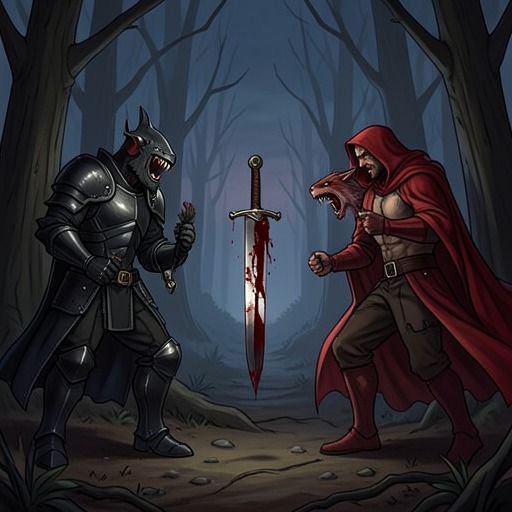
Vampire–shifter war
The Vampire Prince’s BrideThe Vampire–shifter war is the prolonged struggle between the vampire kingdom and shifter clans resisting vampire authority. What first appears to be a series of local attacks becomes a wider conflict involving assassination, territorial invasion, political succession, and the survival of two species whose interests have become irreconcilable. The war’s decisive settlement comes through Darius’s confrontation with the Thunder, but the narrative repeatedly emphasizes that military victory does not erase the deeper conditions that produced the conflict: vampire dependence on humans, shifter opposition to vampire rule, and a cycle in which violence is treated as the only language both sides will recognize.
Origins and Political Stakes
The conflict initially reaches Darius through reports of wolves attacking livestock and a shepherdess disappearing near the frontier. Gordon suspects the Rebeluna, a self-proclaimed rebel movement made up of shifters from various clans that has caused more vampire deaths than any other group during the previous decade. The Rebeluna had already assassinated the colonel assigned to investigate them, which is why the vampire king transferred the inquiry to Darius. Darius first distinguishes the reported incidents from the Rebeluna’s established methods: the group is organized and efficient, whereas the scattered attacks seem more like the work of minor shifters calling themselves rebels without the courage to begin open rebellion.
That distinction collapses when Darius’s troops follow information about a forest camp. A witness has overheard shifters discussing the camp, and drones confirm its existence, although Darius recognizes that the discovery is probably a trap. The operation nevertheless exposes a more serious threat. During the fighting, Darius realizes that the shifters are not merely defending a camp or harassing vampire territory: they are using the engagement to kill him. The surrounding combat is a deliberate assassination attempt, with a giant bear shifter designated to finish him while the other shifters prevent his soldiers from intervening.
The war also carries a dynastic stake. After an attack on Lord Virgil’s position and the death of the king’s heir, Darius understands that his own career and the stability of the vampire kingdom are connected. If the Rebeluna is responsible, the king will ask why Darius failed to discover the plot earlier; if Darius can prove that the attack came from another group, he may preserve his promotion. Rather than defend himself through procedural arguments, he chooses to assume direct Rebeluna responsibility, avenge the king’s heir, and drive the Rebeluna out of the vampire kingdom. He orders three squads to pursue them despite Cleo’s warning that their numbers, command structure, and claimed attacks remain uncertain.
Escalation into Open War
The conflict expands beyond the Rebeluna during a sustained campaign in which Darius and his men endure nearly a week of shifter attacks. Darius spends the brief pauses in combat consuming blood from blood bags while his wounds heal, and his troops use the arrival of helicopters carrying additional blood to reinforce their positions. The shifters’ sudden withdrawal troubles him because it suggests a strategic purpose rather than defeat. His immediate plan is to restock and pursue them, driving them out of vampire territory.
The crucial escalation is the discovery that the shifters are taking orders from a leader known as the Thunder. The war therefore ceases to be an investigation into isolated Rebeluna activity and becomes a coordinated campaign directed by a single, still-unlocated commander. Darius’s language and actions shift accordingly: he is no longer simply searching for fugitives but preparing to confront a military leadership capable of ordering attacks across vampire territory.
The war’s violence is repeatedly set against the possibility of negotiation. Darius does not like killing and never develops the emotional hardness his father expected him to acquire. Cleo matters to him partly because she searches for influence through aid, outreach, and goodwill rather than conquest. She discusses helping communities affected by earthquake flooding and strengthening vampire relations with outlying populations. Her approach reflects the larger political reality that humans are essential to vampire survival, not only as a source of blood but also because vampires are born vampires and, usually, male; without human wives such as Cleo, the vampire population would become extinct within three generations.
This dependence complicates the war’s apparent simplicity. Vampires and shifters are opposing military communities, but humans are caught inside the political and biological structure that sustains vampire society. The conflict is therefore not only a contest over territory. It is also a struggle over the relationships, resources, and social assumptions that allow vampire power to continue.
The Decisive Confrontation
The war reaches its turning point when Darius confronts the Thunder and the shifters agree to settle the conflict through a direct challenge. The terms are personal but carry collective consequences: Darius’s life is placed against the continued presence of the shifter forces in vampire territory. The fighting remains violent, and Darius is forced to defeat a bear shifter before the opposing side accepts the result. Yet the end is not portrayed as a clean triumph. The bear’s death, the injured soldiers, and the naked eagle shifter taken prisoner all preserve the physical cost of the victory.
Darius’s treatment of the defeated shifters reveals the ethical tension at the center of the war. After killing the bear, he refuses to let the dying creature’s last sight be the face of an enemy. He orders one of his men to give the wounded eagle shifter a shirt and delays further treatment until the troops have left the forest. Compassion does not prevent him from fighting, but it prevents victory from becoming simple celebration. His conduct suggests that the war has made violence necessary without making violence morally satisfying.
The shifters ultimately honor the agreement made by their Alpha. One of their leaders tells Darius to take his mate and leave, promising that the shifters will withdraw from vampire territory. Darius returns to Cleo, whose arms are scratched and bleeding, lifts her close, and walks away with her. He believes the shifters will keep their word, and the war is declared over. His private response is sorrow rather than triumph: he wishes the conflict could have ended without violence, while recognizing that at least the fighting has stopped.
Aftermath and Political Reordering
The withdrawal has immediate practical consequences. The Rebeluna pack accepts the Thunder’s terms and retreats with the shifters who had been fighting against the vampire armies. Once they are gone, shifter incidents virtually cease. The end of the war therefore produces a measurable change in vampire territory: the recurring attacks disappear, and the kingdom experiences a period of relief after the prolonged insecurity.
The political consequences are equally important. King Iosif publicly praises Darius for risking his life to drive the shifters out. A three-day celebration follows, after which Iosif declares Darius his new heir. The war thus transforms Darius from a colonel tasked with investigating a rebel movement into the adopted prince and future king of the vampire kingdom. His military success resolves the immediate crisis while also reorganizing the monarchy’s succession.
The ending does not establish that the antagonism between vampires and shifters has disappeared. Earlier, Darius understands the conflict as a collision between two forces that neither side will surrender until something changes. The withdrawal changes the military situation, but it does not erase the social and biological tensions beneath it. The war ends through a bargain enforced by strength, not through reconciliation between the species.
Narrative Significance
The Vampire–shifter war functions as both an invasion narrative and a test of political legitimacy. Its movement follows Darius from investigation to pursuit, from pursuit to military command, and from military command to dynastic elevation. The campaign gives institutional power a visible cost: Darius’s promotion depends on defeating an enemy whose organization he initially misunderstands, and his eventual heirship is inseparable from the deaths and injuries produced by the war.
The conflict also contrasts coercion with persuasion. Cleo imagines aid and improved relations as tools against future violence, while Darius is repeatedly pushed toward raids, retaliation, and open combat. The war’s resolution validates his courage and leadership, but the narrative preserves Cleo’s moral question by having Darius regret that no peaceful solution was found. Victory contains the conflict rather than solving its underlying contradiction.
Finally, the war establishes Darius’s defining balance of force and restraint. He is capable of killing a bear shifter, pursuing an enemy army, and accepting the political burden of command, yet he remains disturbed by killing and attentive to the humanity of defeated opponents. That combination makes the war more than a background struggle between species. It is the crucible in which Darius becomes a ruler: not because violence becomes easy for him, but because he learns to carry its necessity without mistaking it for justice.